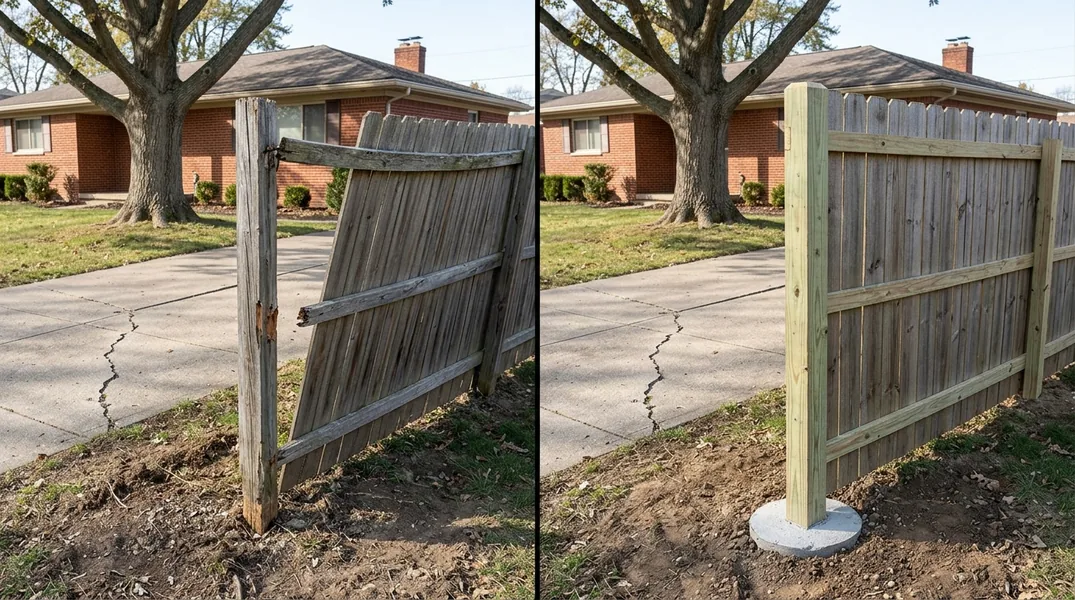
Why Do Fences Lean in Dayton? The Winter Effect
If you've stepped outside after a Dayton winter and noticed your fence leaning or tilting, you're not alone. This is one of the most common problems homeowners face in the Miami Valley, and understanding why it happens is the first step toward fixing it. The culprit isn't usually a single cause but rather a combination of factors unique to our region's climate and soil conditions.
The most significant cause of leaning fences in Dayton is a phenomenon called frost heave. During winter, moisture in the soil around your fence posts freezes and expands. As the ground freezes and thaws repeatedly throughout the season, it pushes upward and sideways, gradually shifting your fence posts out of their original position. This expansion and contraction cycle is relentless, and by spring, many homeowners discover their once-straight fence now has a noticeable tilt. The problem is especially pronounced in Dayton because of our clay-heavy soil, which holds moisture longer than sandy or loamy soil types.
Clay Soil and Frost Heave: A Perfect Storm for Fence Posts
The Dayton area is built on clay soil, which is both a blessing and a curse for fence installation and maintenance. Clay soil provides excellent compaction and stability during normal conditions, but it becomes problematic when water enters the picture. Clay particles are extremely fine and hold moisture exceptionally well, which means water doesn't drain away quickly like it would in sandier soils. When winter arrives and that moisture freezes, the expansion force is tremendous.
Frost heave occurs because ice takes up more volume than water. When the soil around your fence post freezes, it expands with considerable force, literally lifting the post upward and outward. As the ground thaws in spring, the post doesn't always settle back into its original position. Instead, it may shift slightly to one side. Repeat this cycle for several winters, and your fence develops a noticeable lean. This is why homeowners in Kettering, Beavercreek, and surrounding areas experience the same frustrating problem year after year.
Rotted Posts: The Hidden Problem Behind Leaning Fences
While frost heave is the most visible cause of fence leaning, rotted posts are often the underlying culprit. Wood fence posts that have been in the ground for several years are constantly exposed to moisture, which leads to wood rot and decay. Even pressure-treated posts, which are designed to resist rot, eventually succumb to moisture infiltration, especially if the post was not installed with proper drainage considerations. When a post begins to rot, it loses structural integrity and can no longer support the weight of the fence panels and rails.
Rotted posts are particularly problematic because the damage often occurs below ground level, where you can't see it. A post may look fine above the soil line while being completely compromised underground. As the wood deteriorates, the post becomes soft and spongy, unable to resist the lateral forces created by frost heave or wind pressure. This combination of rot and frost heave creates a perfect storm that causes your fence to lean dramatically. If you notice your fence leaning and the post feels soft or spongy when you touch it near the base, rot is likely the problem. This is when professional Wood & Privacy Fence Installation expertise becomes essential to restore your fence's integrity.
Leaning Fence Repair and Fence Post Replacement Near Me
If your fence is leaning, you have several repair options depending on the severity of the problem and the condition of the posts. For minor leans caused by frost heave alone, sometimes a professional can reset the post by re-digging around it, adjusting its position, and re-compacting the soil with proper drainage considerations. However, if the post is rotted, reset alone won't solve the problem. In most cases, fence post replacement is the most reliable and long-lasting solution.
When replacing fence posts in Dayton, it's important to use pressure-treated wood or concrete footings that extend below the frost line, which in our region is typically 36 inches deep. This prevents future frost heave issues. Many homeowners attempt DIY fence post replacement but underestimate the difficulty of the work, especially when dealing with clay soil. Professional contractors have the equipment and experience to remove old posts safely, set new ones at the correct depth and angle, and ensure proper compaction and drainage. This investment in proper installation pays dividends by preventing the same problem from recurring in just a few years.
How to Prevent Fence Leaning After Winter
Prevention is always better than repair when it comes to fence maintenance. The best way to prevent fence leaning is to ensure proper installation from the start. When posts are set deep enough, below the frost line, and with adequate concrete footings, frost heave becomes much less of a problem. Additionally, proper drainage around the post base is critical. Water should be directed away from the post, not pooled around it, so the soil doesn't become saturated before winter arrives.
If you already have a fence that's prone to leaning, there are steps you can take to minimize damage during winter. Ensure gutters and downspouts direct water away from fence lines. Fill any low spots near the fence where water collects. In areas where water does accumulate, consider installing a simple drainage solution like a French drain or gravel trench. These preventative measures reduce the amount of moisture in the soil around your posts, which directly reduces frost heave forces. For homeowners in Huber Heights and throughout the region, proper maintenance during fall is crucial. Clear debris from around fence posts and ensure the ground slopes away from the fence to promote drainage.
Fence Post Repair Cost in Dayton: What to Budget
The cost of repairing or replacing leaning fence posts in Dayton varies depending on several factors, including the number of posts that need replacement, the depth of installation required, soil conditions, and whether you need panel repairs as well. A single post replacement typically ranges from a few hundred dollars to over a thousand, depending on these variables. If multiple posts need replacement or if panels are damaged from the leaning, costs increase accordingly.
Rather than guessing at what your repair will cost, the best approach is to contact Dayton Fence Company for a professional assessment. We can evaluate your fence, identify which posts are compromised, and provide accurate pricing for the work needed. Many homeowners are surprised to learn that the cost of proper post replacement is reasonable compared to the cost of replacing an entire fence later due to neglect. If you're ready to address your leaning fence, call us at (937) 930-3672 or request a free estimate online. We serve Dayton and the surrounding communities with professional fence repair and installation services.
Looking for a professional tree service in Dayton? Dayton Fence Company responds fast for all your fence needs.
Get a Free Quote