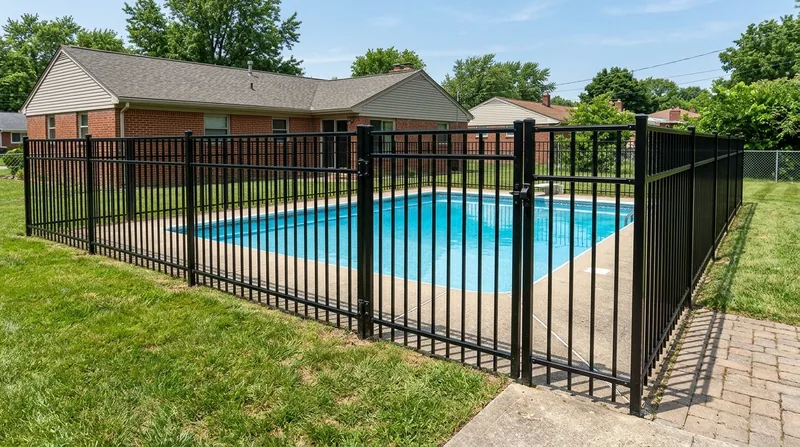




Pool fence installation in Dayton is a code-driven project that protects children and meets Ohio barrier requirements. Whether you have an above-ground pool, an in-ground installation, or a spa, a properly installed pool barrier, aluminum, mesh, or glass, stops unauthorized access and keeps your property compliant with local safety standards. Dayton homeowners in neighborhoods across the city, from Kettering to Beavercreek to Centerville, rely on pool fencing to satisfy both municipal code and insurance requirements. A pool fence is not a discretionary upgrade; it is a legal safety boundary. We install pool safety fences that meet the codes applying at your address, using durable materials and self-closing, self-latching hardware that performs year after year.
Why Pool Fence Installation Matters in Dayton
Ohio law and local building codes establish minimum standards for pool barriers, including height, gap spacing, and gate operation. A pool fence is the primary barrier between a pool and the surrounding property. Non-compliant barriers create liability exposure, void insurance coverage, and violate code. In Dayton and the surrounding communities, pool barriers are inspected by the building authority and must remain in compliance for as long as the pool exists. A properly installed fence with a self-closing self-latching gate is the difference between a passing inspection and a citation.
- We install aluminum, mesh, and glass pool barriers to the barrier code that applies at your address.
- All gates are fitted with self-closing and self-latching hardware that requires no manual operation.
- Gate height, hinge placement, and gap clearance are measured and set to code during installation.
- We pull Ohio 811 utility locates before any post holes are dug, protecting underground lines.
- Final inspection is your responsibility with the local authority having jurisdiction, and we provide documentation to support your compliance review.
A pool barrier installed to code is inspected once and legal for good, provided it is maintained and gates remain functional.
Key info: Dayton building code and Ohio state law both govern pool barriers. Contact the Dayton City Building Department or your local jurisdiction to confirm the exact height, gap, and gate requirements for your property. We work from those requirements and install to meet them.
For detailed guidance on pool barrier codes and inspection procedures, refer to the City of Dayton Building Department.
How We Install Pool Fences in Dayton: Our Process
Pool fence installation begins with a site visit to measure the pool perimeter, identify the barrier line, and understand the local code that applies. We assess soil conditions, drainage, and access to determine the best installation method. All work starts with an Ohio 811 utility locate call to mark underground lines. Posts are then set, rails and infill are installed, and gates are hung and tested for proper operation before we leave the site.
- We visit your property to measure the pool perimeter and review the local code requirements with you.
- An Ohio 811 utility locate is called at no charge to identify underground lines before digging begins.
- Posts are set in concrete at spacing required by code, with proper depth and tamping for stability.
- Aluminum or mesh infill is attached to the frame, with all fasteners sealed against weather.
- Gates are hung, tested for smooth swing, and verified for self-closing and self-latching operation.
- A final walkthrough confirms the barrier is complete, safe, and ready for inspection by the local authority.
The entire process takes one to three days depending on pool size and barrier type. We work efficiently without cutting corners on code compliance or material quality.
Example: A homeowner in Beavercreek with a 15-by-30-foot in-ground pool needed an aluminum barrier meeting Beavercreek code. We measured the perimeter, called 811, set posts 6 feet apart, installed aluminum infill with a self-latching gate, and completed the job in two days. The barrier passed inspection on the first review.
For more information on how we handle related gate work, visit our gate installation and repair page.
Pool Fence Materials: Aluminum, Mesh, and Glass
Three primary barrier types meet pool code in Ohio: aluminum, removable mesh, and tempered glass. Each has distinct strengths in durability, aesthetics, and cost. Aluminum is rigid, permanent, and low-maintenance. Mesh pool fences are removable and store compactly when the pool is not in use. Glass barriers offer unobstructed sightlines and a premium appearance. The right choice depends on your code, budget, and preference.
| Material | Description | Best for |
|---|---|---|
| Aluminum | Rigid, powder-coated frame with aluminum or vinyl infill. Permanent installation. Low maintenance. Available in multiple colors. | Homeowners seeking a durable, low-maintenance permanent barrier that requires no seasonal removal or storage. |
| Removable Mesh | Lightweight mesh fabric tensioned between aluminum posts. Removed and stored in off-season. Quick to install and remove. Meets code when properly tensioned. | Homeowners with seasonal pools or those who prefer a temporary barrier that can be removed when the pool is not in use. |
| Tempered Glass | Frameless or framed tempered glass panels. Premium appearance. Transparent, allows sightlines into the pool area. Requires careful handling and cleaning. | Properties where aesthetics are a priority and budget allows for a high-end, transparent barrier that maintains an open appearance. |
| Aluminum Pool Gate | Swing or sliding gate with self-closing and self-latching hardware. Meets code for gap and latching force. Tested for operation before handoff. | Any pool barrier installation where code-compliant access control is required. Gates are the critical compliance component of the barrier system. |
Pool Fence Installation Cost in Dayton: What to Expect
Pool fence installation cost in Dayton ranges from $32 per linear foot for basic aluminum barriers to $60 or more per linear foot for glass or premium mesh systems. A typical residential pool barrier of 150 linear feet in aluminum runs $4,800 to $9,000, depending on gate type, site access, and whether posts need concrete removal or rework. Mesh barriers cost less upfront but are removable and require annual installation and storage labor. Glass barriers command the highest per-foot cost due to material and specialized installation. The total investment depends on perimeter length, material choice, and local code requirements.
Several factors move the price: pool shape and perimeter length, material (aluminum is mid-range, mesh is lower, glass is premium), gate type and quantity, soil conditions (hard-packed soil or clay may require extra post-setting labor), and whether existing posts or structures can be reused. We recommend getting two to three estimates to compare approach and price. A written estimate should itemize material, labor, and any site-specific work (utility locates, old fence removal, or post rework).
For a detailed pricing overview and a breakdown of what moves the cost up or down, visit our full pricing page.
What to Look for When Hiring a Pool Fence Contractor Near Me in Dayton
Hiring a pool fence contractor is a decision that affects safety and code compliance. Look for a contractor who is fully insured, holds a recognized credential (such as American Fence Association membership), and can walk you through the local code and what it means for your property. Ask for references from recent pool fence jobs. Understand whether the contractor will handle the Ohio 811 utility locate, pull permits if required, and coordinate with the local building authority. Request a written estimate that breaks down material, labor, and any site-specific costs. A contractor who listens to your needs and explains the code clearly is one you can trust.
- Confirm the contractor is fully insured and carries a recognized trade credential or membership.
- Ask for references from pool fence installations completed in Dayton or nearby communities within the past two years.
- Verify that the contractor will call Ohio 811 before digging and will handle any required permits.
- Request a written estimate that itemizes material, labor, and any additional site work.
- Confirm that the contractor understands the specific code requirements for your local jurisdiction and will install to meet them.
- Ask whether the contractor provides documentation or a compliance checklist to support your final inspection with the building authority.
A contractor who is transparent about code, willing to answer questions, and committed to a clean, compliant installation is your best choice. Contact us at (937) 930-3672 for a free estimate. We have installed pool barriers across Dayton since 2013 and are an AFA Member Installer.
Pool Fence Installation in Dayton: Pricing Guide
| Service | Price | Details |
|---|---|---|
| Aluminum pool barrier | Starting at $32/ft | Includes posts set in concrete, aluminum infill, self-closing gate, and code compliance inspection. |
| Removable mesh pool fence | Starting at $24/ft | Aluminum posts with tensioned mesh infill. Lower cost than aluminum. Requires seasonal removal and storage labor. |
| Tempered glass pool barrier | Starting at $60/ft | Premium transparent barrier. Includes framed or frameless glass panels, posts, and self-latching gate hardware. |
| Pool gate installation or replacement | Starting at $800 | Self-closing, self-latching hardware, hinges, tested for proper operation, and code compliance verification included. |
| Ohio 811 utility locate | Included | Called at no charge before any post holes are dug to identify and mark underground lines. |
| Free estimate | No obligation | Site visit, code review, material options, and written quote. Response within 24 hours at (937) 930-3672. |
Indicative pricing, the exact cost depends on square footage, finish, and site access. Free personalized estimate within 24h at (937) 930-3672.


